Chelsea Market occupies a former National Biscuit Company complex in Manhattan’s Meatpacking District. Buying lunch is one way to use it; examining how a factory became a place for food retail reveals a longer urban story. The building belongs to a district where production, storage and transportation once shaped the streets as strongly as shops and restaurants do today.
Food moved through buildings, not just shop windows
The High Line’s historical material describes a factory complex constructed and expanded in stages from the late nineteenth century into the twentieth. Rail service was closely connected to the operation. Tracks associated with the elevated freight line carried ingredients into the buildings and finished products out of them.
This relationship helps explain why an industrial building can be much larger and deeper than an ordinary storefront. Factories need room for processes, equipment and circulation. Loading and dispatch require their own connections to the street or railway. A food market placed inside that fabric inherits dimensions established for a different type of activity.
The National Biscuit Company name, later shortened to Nabisco, connects this particular place to the industrial production of packaged food. It is a different food history from that of a farmers market, where growers sell directly to customers. Both involve food, but the chain between producer and buyer is organized differently.
What adaptive reuse keeps and changes
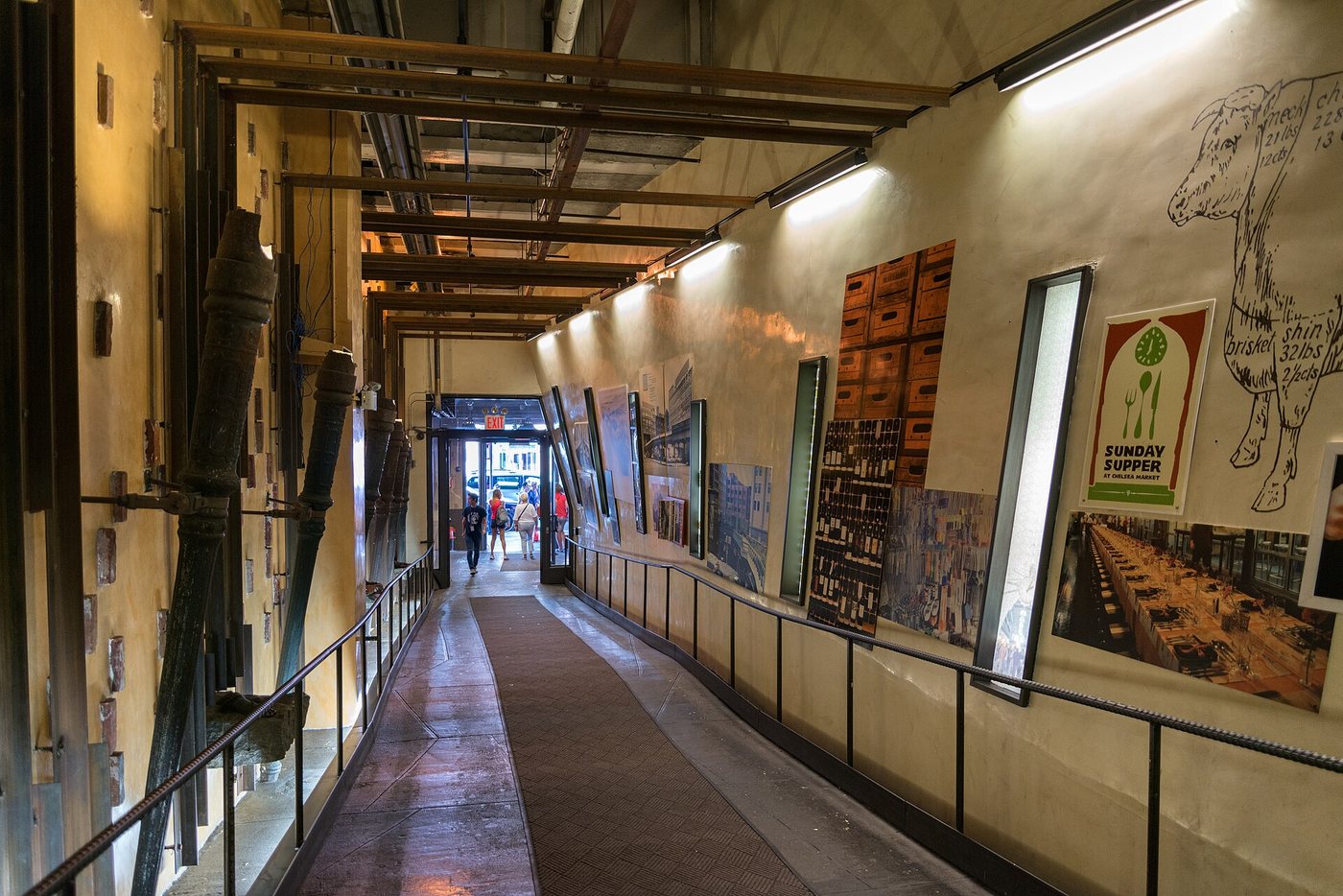
Brick surfaces and industrial proportions contribute to the market’s atmosphere, yet the present interior is not a preserved factory floor operating as it once did. Shops need customer entrances, signs, utilities and routes that make sense to shoppers. A successful conversion must accommodate those requirements within the inherited structure.
When walking through, look at the scale of openings and the relationship between the main passage and individual businesses. The passage serves as a shared indoor street. Merchants have separate identities, but their entrances face a common flow of people. That arrangement encourages browsing while retaining the sense of a connected building.
Exposed materials alone cannot establish the age of a feature. Some elements may be historic, others repaired, moved or introduced during conversion. Treat visual clues as starting points for questions rather than proof that everything visible dates to the biscuit works.
Connect the market to the district
The nearby High Line provides another example of reuse, this time involving transport infrastructure. Considering the two together makes their former relationship easier to understand: the railway was part of the machinery of commerce, not originally a garden above it.
For food shopping, use the market’s current merchant directory because tenants and menus change. For an architectural visit, pause where circulation is wide enough to avoid blocking a business entrance. A useful question to carry away is how much of a district’s working past remains readable after its economic purpose changes. At Chelsea Market, the answer lies in the building’s size and connections as much as in its decorative details.