
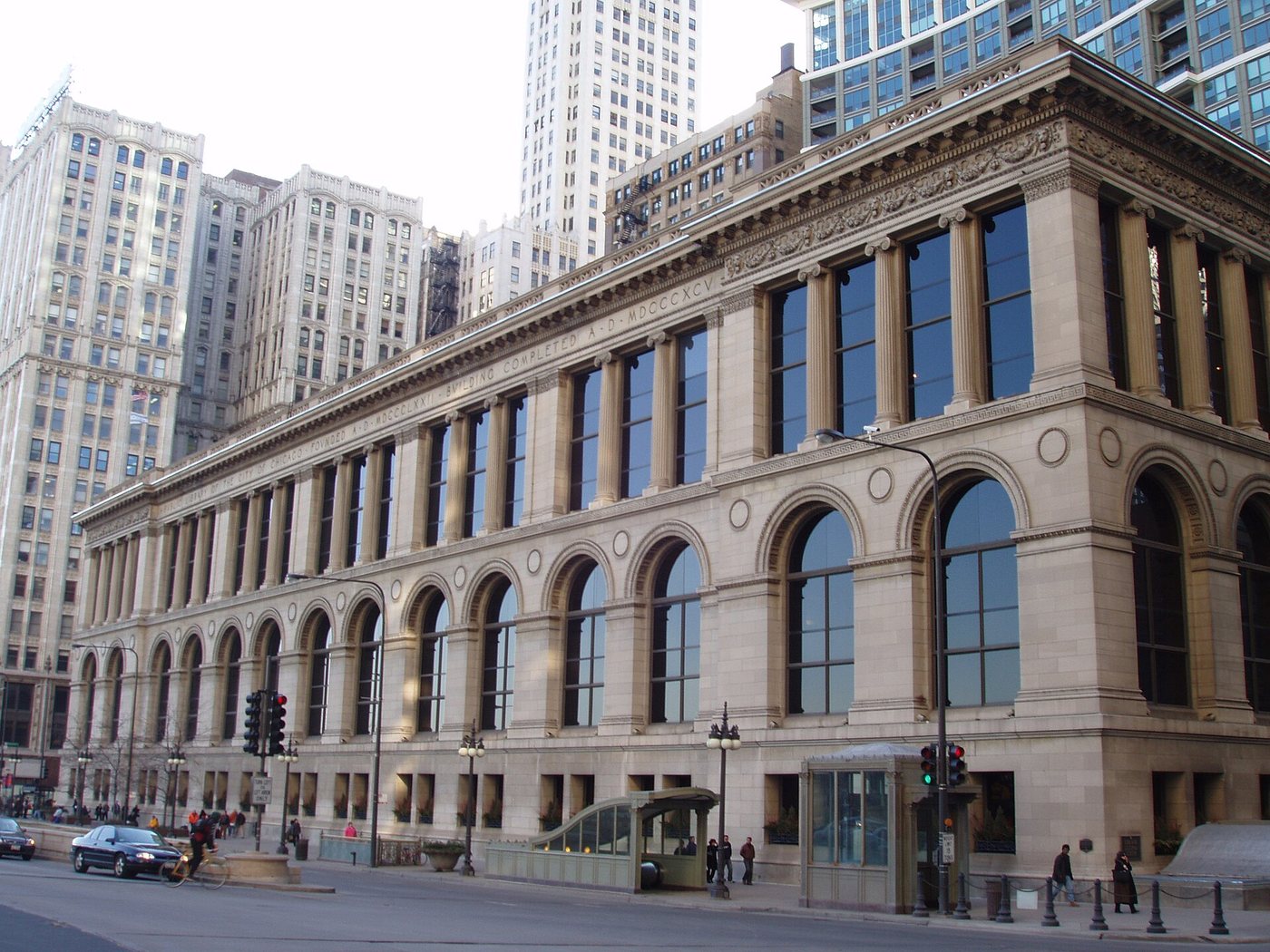
The Chicago Cultural Center is often visited for its stained-glass domes, but its rooms make more sense when their original purposes are understood. The building opened in 1897 as Chicago’s central public library and also accommodated a memorial and meeting spaces for Union veterans of the Civil War. The coexistence of those functions explains why its interiors do not all tell the same story.
A shared site and a negotiated building
Chicago Public Library’s historical account describes competing claims on the Dearborn Park site. The library wanted a permanent home, while the Grand Army of the Republic, a Union veterans’ organization, wanted its own building. A compromise allocated space to the veterans within the library project. The result combined a place for reading and learning with rooms devoted to remembrance and association.
That arrangement is useful to keep in mind when moving between the building’s different areas. The grand interior is not simply one decorative scheme repeated from room to room. The library spaces celebrate literature and knowledge, while the memorial spaces address military service and civic memory.
The architects were Shepley, Rutan & Coolidge. Their design drew on classical and Renaissance precedents, giving a municipal institution an architectural language associated with permanence and public importance. At street level, the building’s broad mass and regular openings establish a very different rhythm from the tall commercial buildings around it.
Read the stair as an introduction to the library
The Washington Street entrance and its staircase lead into a sequence of surfaces covered in inscriptions, mosaics and varied materials. Chicago Public Library identifies authors’ names, printers’ marks and quotations associated with learning among this decoration. The ornament is therefore part of an argument about what the institution represents, not simply a display of expensive craft.
Try looking at one small section rather than scanning every surface. A printer’s emblem, a name and a quotation perform different tasks. One recognizes the production of books, another places an individual within a cultural tradition, and another states an ideal. Together they turn the building itself into something that can be read.
This also reveals the limits of the decorative program. A selection of celebrated names reflects the values and judgments of the people who commissioned it. It is not an exhaustive list of everyone who contributed to knowledge. Historic interiors can be admired for their workmanship while still being understood as products of a particular time.
The domes belong to different rooms
Preston Bradley Hall contains the Tiffany dome associated with the former library. The Grand Army of the Republic spaces form a separate memorial sequence. Describing both domes simply as one attraction loses that distinction, and attributing every decorative feature to a single maker can be misleading. Use the city’s room-specific interpretation when identifying individual works.
A dome changes a room through light as well as shape. Its position draws the eye upward and organizes attention around a center. The experience at floor level depends on the surrounding walls, openings and furnishings; a close-up photograph of glass cannot convey the whole spatial effect.
The transition between an entrance, a stair and a high room is equally important. Architecture works through sequences. The anticipation created by moving through a smaller space can make the next room feel larger than its measurements alone suggest.
A cultural building after the library
The building became the Chicago Cultural Center in the late twentieth century, and library functions eventually moved to the Harold Washington Library Center. Its continuing public use involves exhibitions, performances and other programming. This is an adaptation of a civic building, not the freezing of every room at its opening-day arrangement.
Consult the city’s current visitor information before planning around a particular exhibition or room. Formal posed photography has its own permit rules, distinct from an ordinary visit. Keep quiet around performances and avoid blocking circulation while looking upward. The building rewards close attention, but its present cultural activities are part of the place’s story too.


.jpg)
