
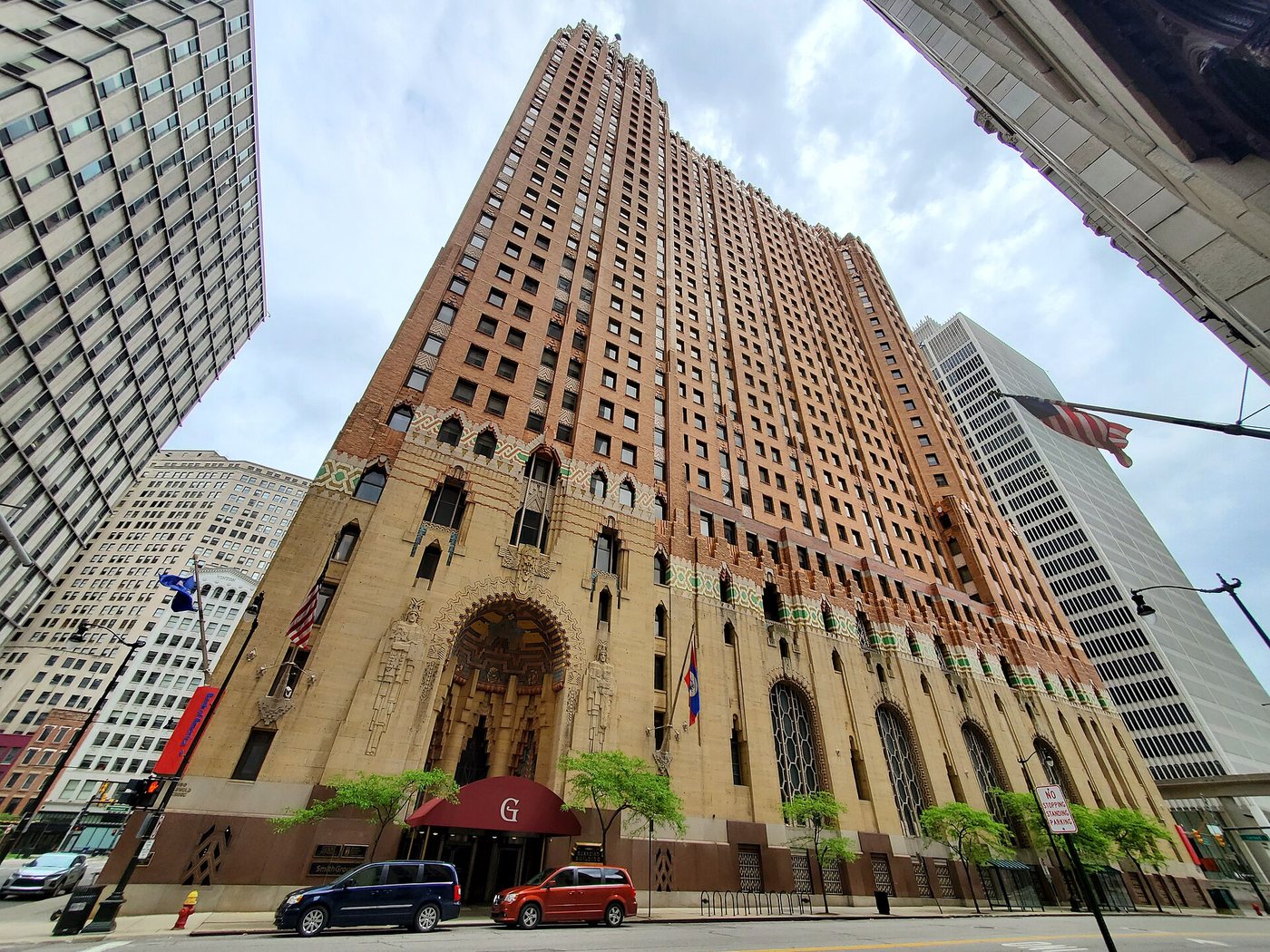
The Fisher Building has two distinct public faces. From a distance, its tower marks Detroit’s New Center skyline. Close to the entrance, marble, metalwork and painted surfaces turn attention toward craftsmanship. The change in scale is central to understanding a headquarters that was also designed to accommodate shopping and entertainment.
An automobile fortune becomes a civic interior
The Fisher brothers chose New Center when space for their headquarters was limited downtown. They commissioned Albert Kahn in 1927, and the building was completed the following year. The enterprise behind it was Fisher Body, connecting the building’s elaborate finish to the wealth generated by automobile manufacturing.
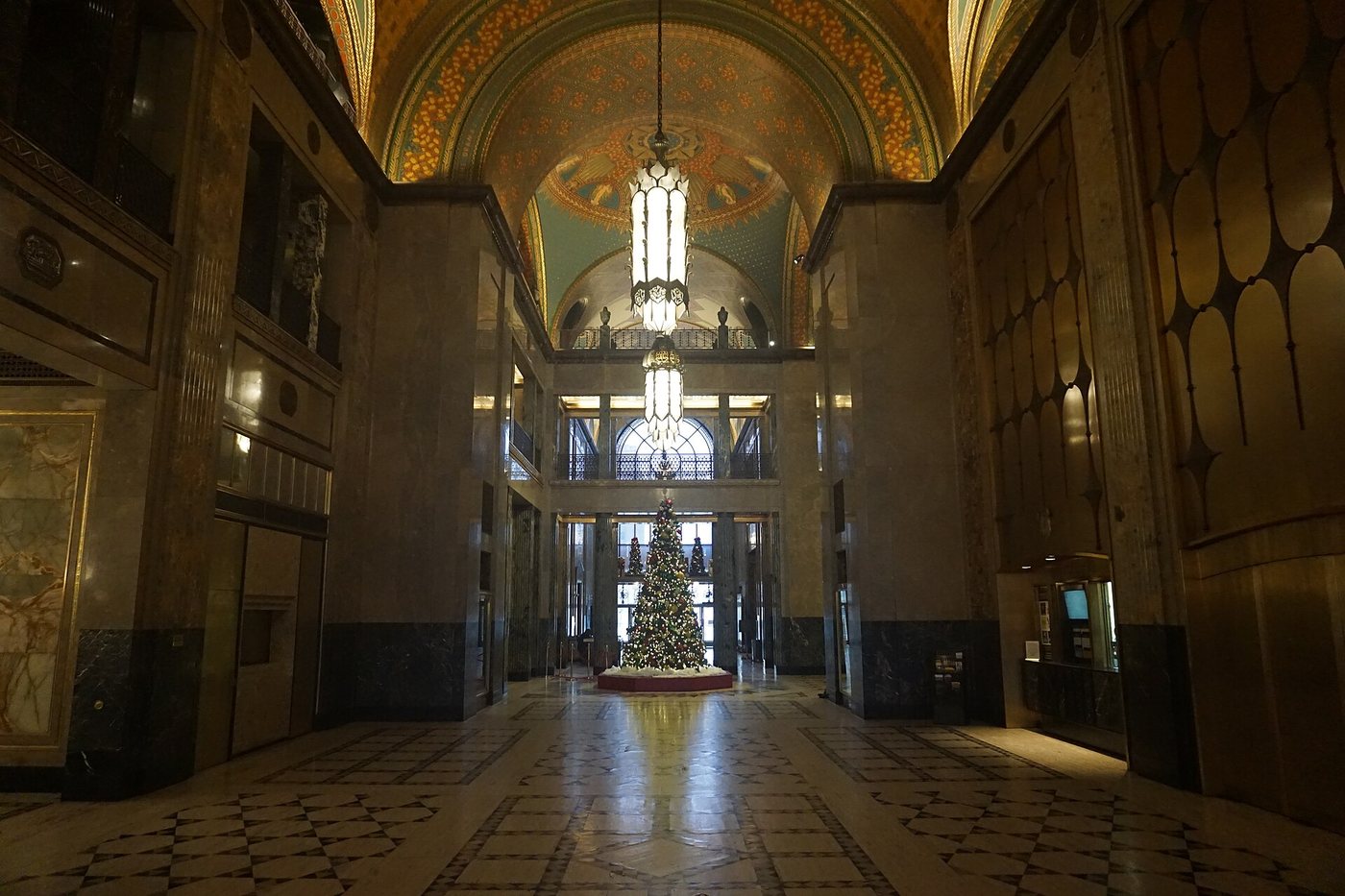
Inside, the three-story arcade gives decoration a space much larger than a normal office lobby. Its barrel-vaulted ceiling, mosaics and bronze details work together: the vault establishes the volume, while the smaller pieces reward attention at walking pace. This is an interior organized for circulation, so its ornament is encountered while entering, crossing and moving between uses.
A golden appearance with a material history
The tower’s gold appearance has not always come from the same material. According to the building’s history, its original gold-leaf tiles were covered during the Second World War because of fears about bombing. Damaged tiles were subsequently replaced with green terra cotta, which is illuminated to appear gold at night.
That sequence is a useful correction to the assumption that an iconic skyline feature is unchanged. Lighting can maintain a familiar visual identity after materials have altered. It is worth separating what is seen from far away from what the building is physically made of; the two accounts are related but not identical.
Keeping an elaborate building in use
The Fisher’s preservation has included restored painted decoration alongside upgrades to mechanical equipment, elevators and fire suppression. The less visible work supports the continued use of the visible interiors. Decorative restoration and building services consequently belong to the same story, even if only one attracts photographs.
A visit is best organized around the arcade and an authorized tour where available. Office and entertainment uses have their own arrangements, and an open entrance does not make every upper floor a sightseeing area. From the accessible spaces, the Fisher can be understood as a working complex whose architecture extends from a skyline marker down to the detail of a doorway.
.jpg)


