
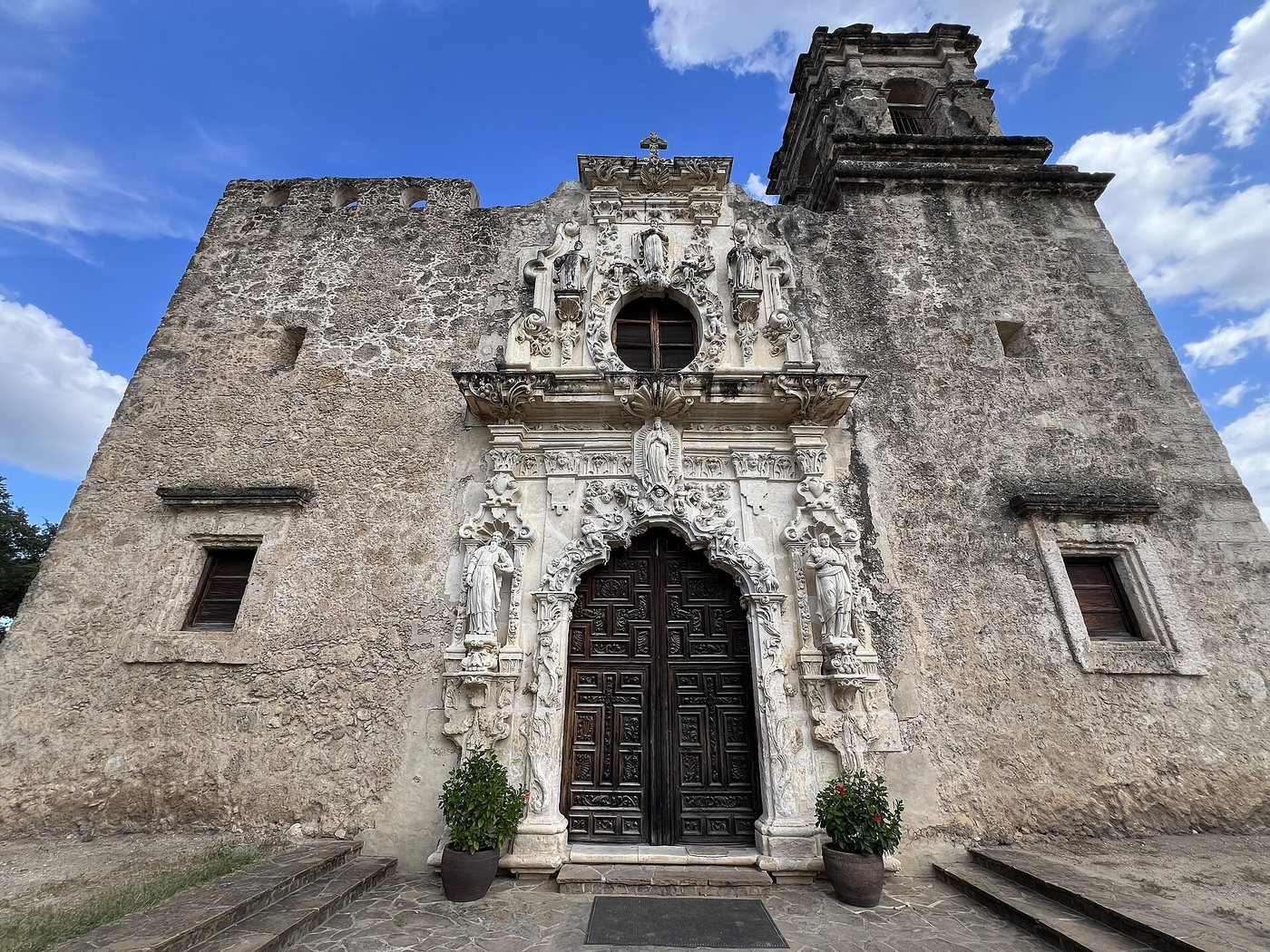
Mission San José is a large enclosed settlement, not simply a church standing in a park. Its walls, living quarters, religious spaces and nearby mill illustrate a colonial system that reorganized Indigenous lives and labor. The site is also extensively restored, so understanding what was rebuilt is essential to understanding what the visitor sees.
The mission moved before settling here
Founded in 1720, San José occupied earlier locations before moving to its present site around 1740. The National Park Service connects those moves with practical pressures, including proximity to the river and an epidemic. The stone enclosure was completed in the mid-eighteenth century.
The walls performed two jobs: they enclosed the community for defense and incorporated living quarters. At the mission’s eighteenth-century peak, hundreds of people lived within the compound. Looking only at the church facade can therefore distort the scale of daily life. The perimeter was not simply a boundary around a monument; it contained homes and helped organize a community.
Colonial aims and Indigenous lives
The National Park Service describes the mission’s objective as converting Indigenous people into Catholic subjects of the Spanish crown. Families entered under pressures produced by a rapidly changing world. Religious instruction and scheduled work altered language, diet, clothing and social routines.
Indigenous people were not incidental laborers in a story belonging only to missionaries. They built acequias, worked stone, produced textiles, tended crops and livestock, prepared food and maintained households. The park’s account also notes that leaders of Indigenous bands received community offices such as governor, judge and sheriff. These roles existed within a colonial system rather than outside it.
The physical plan helps convey that system. Housing, work and worship were placed in a controlled relationship, while fields and ranching extended beyond the enclosure. A pleasant open courtyard today should not obscure the regulation that structured life within it.
Water connected agriculture and machinery
The gristmill beyond the main walls adds a mechanical dimension to the site. The park dates its completion to 1794, the year of a successful wheat harvest after earlier cultivation attempts had failed. Water from the acequia powered the mill rather than merely irrigating fields.
The operating sequence explains the surviving layout. Water was diverted into a forebay, held and released through a channel to turn a horizontal wooden wheel. That motion drove the grinding stones above. After doing work at the wheel, the water could continue toward a field. The system used the same resource in more than one way.
At the mill, the relation between holding water, controlling its release and transferring motion matters more than the picturesque appearance of the small building. The park also identifies remnants of lime kilns nearby, connecting the location with earlier production of building material.
The twentieth century is visible too
The National Park Service calls San José its most restored mission site. Work in the 1930s rebuilt or restored walls, portions of the church, the granary and the mill. The enclosure’s present completeness should therefore not be taken as proof that every surface has stood unchanged since the colonial period.
Reconstruction can make a lost spatial relationship easier to grasp. It can show how rooms and walls formed a working compound even when substantial fabric had disappeared. At the same time, interpretation must identify that intervention so visitors can distinguish surviving evidence from a later representation.
This is not a reason to dismiss the site as a replica. Its significance includes its location, surviving fabric, archaeological knowledge, religious continuity and the history of preservation. Each contributes a different kind of evidence.
Give the compound enough time
Begin with the park visitor center rather than heading directly to the best-known church detail. The museum and park film establish the broader mission system, making the housing and work areas easier to interpret. Then follow the compound’s perimeter and include the mill if it is available during your visit.
San José is part of a larger group of missions connected with the San Antonio River. It is possible to study this one site closely without treating all of them as a compulsory same-day checklist. Check the park’s current information for access and ranger activities, and remember that religious use and heritage interpretation share the site.
.jpg)
