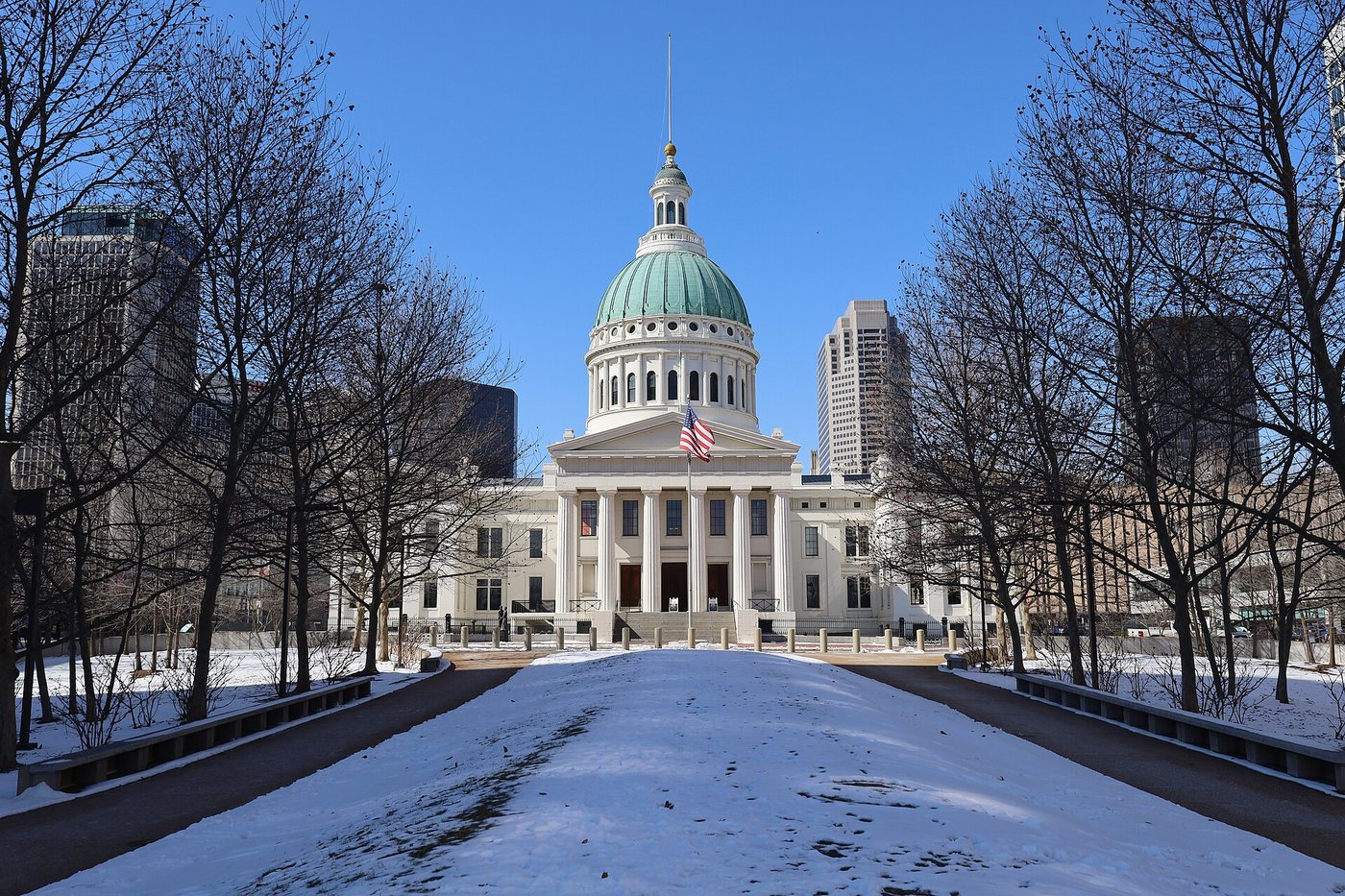
The Old Courthouse in St Louis is both a surviving civic building and a place where the meaning of rights was contested. Its dome and rotunda offer an architectural introduction, but the strongest reason to spend time inside is the connection between named people, particular proceedings and the institutions that shaped their lives.
Follow the Scotts’ case through its stages
Dred and Harriet Scott filed separate petitions for freedom in 1846. The first two local trials took place in the courthouse in 1847 and 1850. Their initial loss was followed by a judgment in their favor, which was subsequently overturned. The sequence matters because the struggle did not consist of one hearing with one final result.
The case later moved into the federal courts and reached the United States Supreme Court. The notorious 1857 decision denied Scott relief and asserted a deeply exclusionary understanding of citizenship while protecting slavery. The National Park Service chronology places that decision within the family’s longer effort to secure freedom.
Keep Harriet Scott visible in the story. A case commonly identified by Dred’s name concerned a family and began with petitions by both spouses. Museum interpretation can recover that wider human setting from the shorthand by which a major court decision is usually remembered.
The local trials and the Supreme Court decision also occurred in different institutional settings. Standing in the Old Courthouse does not mean standing in the room where every later stage happened. A place can be central to a legal history without containing all of its events.
The courtroom does not survive unchanged
The NPS explains that the original courtroom used for the Scott trials no longer exists in its earlier form. In 1855, structural concerns led to changes that divided the large first-floor west-wing room with a corridor. This alteration occurred before the family’s legal struggle had ended.
That fact is an important guide to visiting historic sites. A building can retain an authentic connection to an event even when the specific room has been altered. The evidence comes from records, plans and interpretation as well as from the surviving surfaces a visitor can see.
Look for labels that distinguish original features, later additions and reconstructed explanations. The distinction does not diminish the site. It prevents an imagined untouched scene from replacing the more complicated history of a working public building.
Other claims to rights entered the same building
Virginia Minor’s voting-rights case came to trial here in the 1870s. The park presents it alongside other historic proceedings to examine citizenship and participation. The courthouse therefore provides a setting for more than one struggle over who could exercise rights and how those claims were heard.
It also served ordinary civic functions in a growing city. The NPS records that court use ended in 1930 and that the city transferred the property to the National Park Service in 1940. Its current museum role is a later chapter, created through a decision to preserve and interpret the building.
The rotunda’s murals add another layer. They are historical representations made at particular dates, rather than neutral windows onto every community’s experience. Their subjects and visual priorities can be compared with the questions raised by the modern exhibits.
A renewed museum within an older structure
The courthouse reopened in May 2025 after renovations that included an elevator, building-system work, restoration and new exhibition galleries. Improved access and modern services allow an old structure to continue receiving visitors without pretending that nineteenth-century arrangements were adequate for everyone.
Begin with the building’s layout, then follow one case carefully through the exhibits. Note which court heard each stage and how the outcome changed. This approach is more informative than remembering only a famous name or a date.
Finally, compare the courthouse with the Arch grounds outside. The park joins a monumental account of national expansion with a place where the boundaries of freedom and citizenship were contested. Giving both parts time makes the visit more historically substantial than treating the courthouse as a foreground for an Arch photograph.