
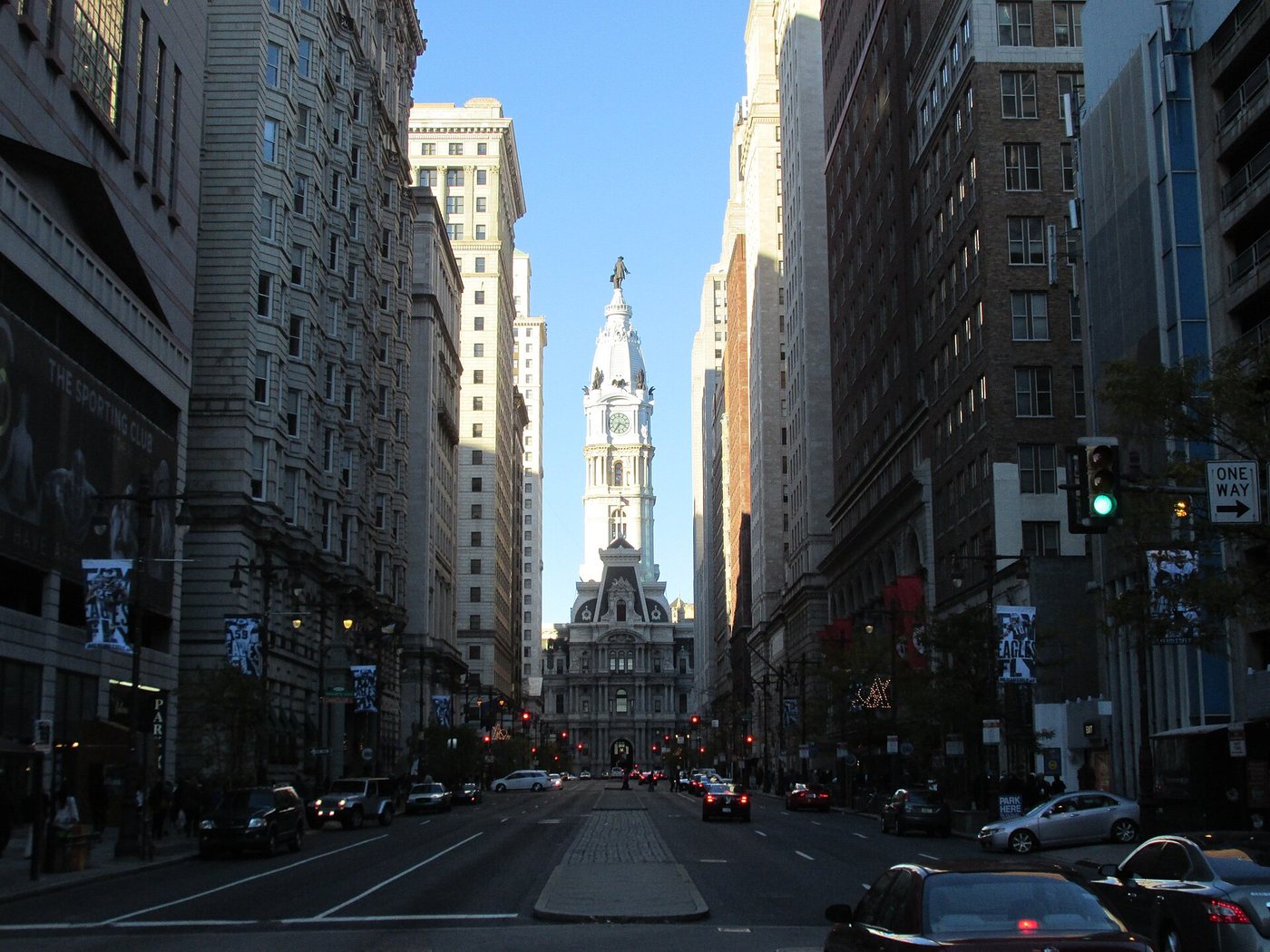
Philadelphia City Hall occupies the meeting of Broad and Market Streets, at the site reserved as Centre Square in William Penn’s plan. Its position gives the building an unusually direct relationship with the city grid. Streets approach it as a destination, traffic moves around it, and pedestrian passages lead through it. The building is both an institution and an obstacle around which central Philadelphia organizes movement.
A center given architectural weight
John McArthur Jr. won the design competition in 1869, and construction extended from 1871 to 1901. The long building period helps explain why City Hall should be understood as a major civic undertaking rather than a structure produced in one brief campaign. Its Second Empire architecture uses a dense combination of roofs, pavilions, windows and sculptural detail.
The building’s broad footprint fills the central site, while its tower marks that location at a distance. These two scales perform different jobs. The lower walls define the streets and passages experienced by pedestrians; the tower identifies the civic center within the wider skyline.
Sculpture belongs to the architecture
Alexander Milne Calder designed the famous bronze figure of William Penn above the tower. The building also carries a much larger sculptural program distributed across its exterior. The summit figure is therefore the most conspicuous part of a broader effort to attach historical and civic meaning to the building.
At street level, sculpture and architectural ornament operate at a closer range. They break down the enormous facade into smaller elements, although their density can make them difficult to absorb all at once. The building rewards attention to one entrance or portion of wall rather than an attempt to identify every figure from a single position.
Through a building, around a building
City Hall’s central courtyard and passages complicate the idea that its footprint simply blocks the street grid. Pedestrian movement can enter the building’s own spatial system, while surrounding public spaces provide places to approach and view it. The transition from street to passage to courtyard makes the civic building part of a route.
Its continued governmental use also matters. Architectural access and access to working offices are different things. The public exterior can be understood independently of any tower visit or organized tour. The essential urban fact is visible from the surrounding streets: Philadelphia placed a monumental municipal building at the point where two principal axes meet, and the city continues to negotiate movement around that decision.

.jpg)
