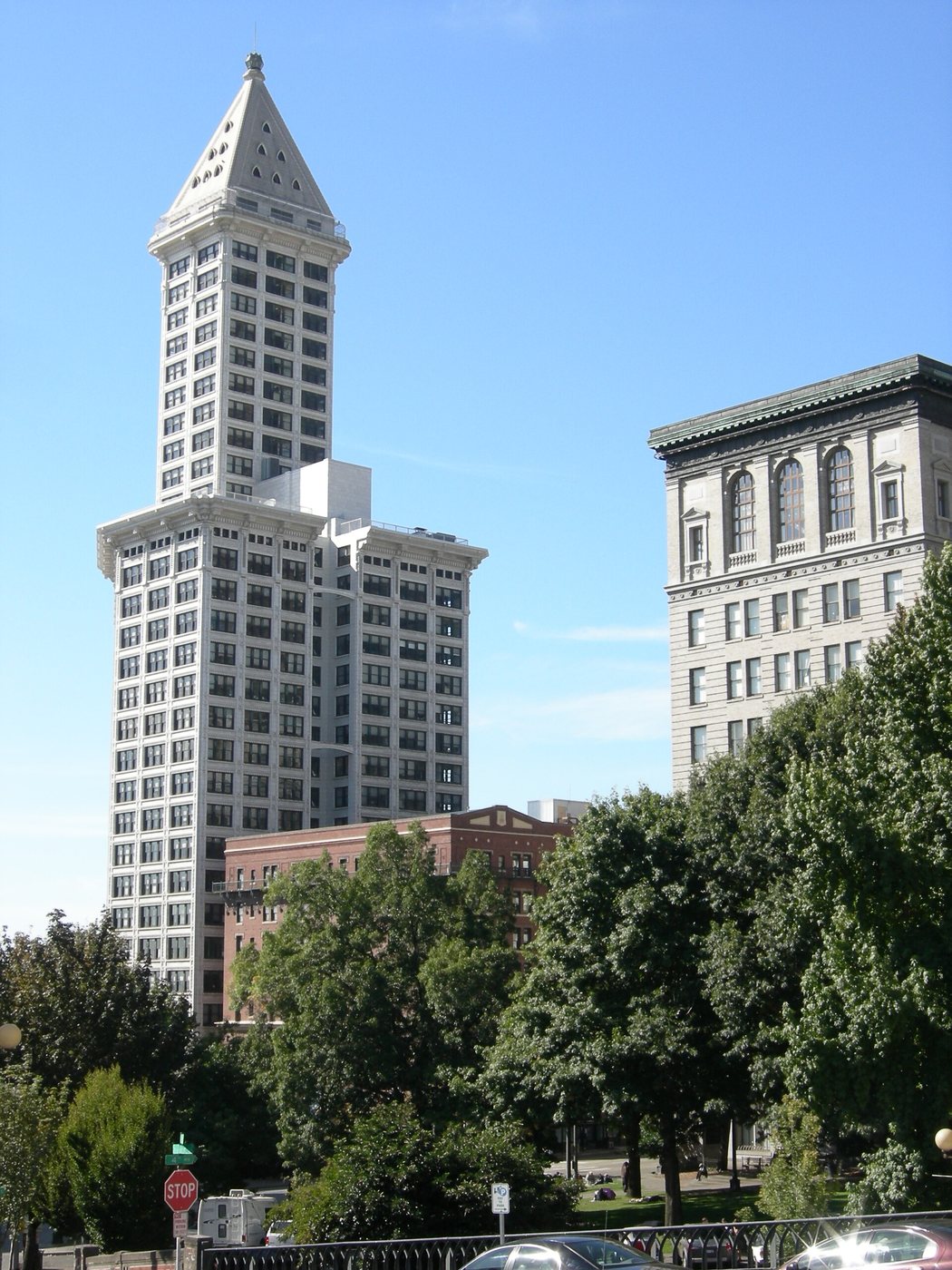
Smith Tower opened in 1914 at Second Avenue and Yesler Way, introducing a conspicuous vertical landmark beside Seattle’s older commercial district. Its white terra-cotta exterior contrasts with many nearby brick and stone buildings. The tower’s significance is not only its height, but the way a narrow upper shaft rises from a broader base to produce a recognizable skyline form.
An ambitious project grew taller
Lyman Cornelius Smith acquired the site in 1899. Early proposals were considerably lower than the building eventually constructed. Plans expanded as the project became an expression of commercial ambition and competition within the growing city.
The Syracuse firm Gaggin and Gaggin designed the tower. Construction began in 1911, and the steel frame reached completion in 1913 before the building opened the following year. Smith did not live to see the finished project, so the building’s name also became a memorial to its developer.
A pale shaft above a strong base
The lower portion meets the street with a more substantial mass, while the tower narrows above it. This distinction helps a tall building relate to two scales at once: the pedestrian streetscape and the distant skyline. The pale cladding reinforces its visibility against darker surrounding structures.
Terra cotta was useful for architectural detail as well as surface treatment. It allowed the exterior to carry a consistent appearance over the steel-framed building. The visible skin and the structural system therefore perform different roles, even when they are experienced together as one landmark.
An observatory creates another public role
The upper observatory drew visitors from the opening day. It offered a way to see the city from a height that ordinary streets could not provide. That public attraction coexisted with the building’s office functions rather than replacing them.
Later changes in Seattle’s skyline have altered the tower’s relative prominence, but its distinct form remains recognizable. Its historical value does not depend on retaining a height record indefinitely. Smith Tower records a moment when commercial development sought to make a new kind of vertical claim on the city, while its continued use adds later chapters to that ambition.