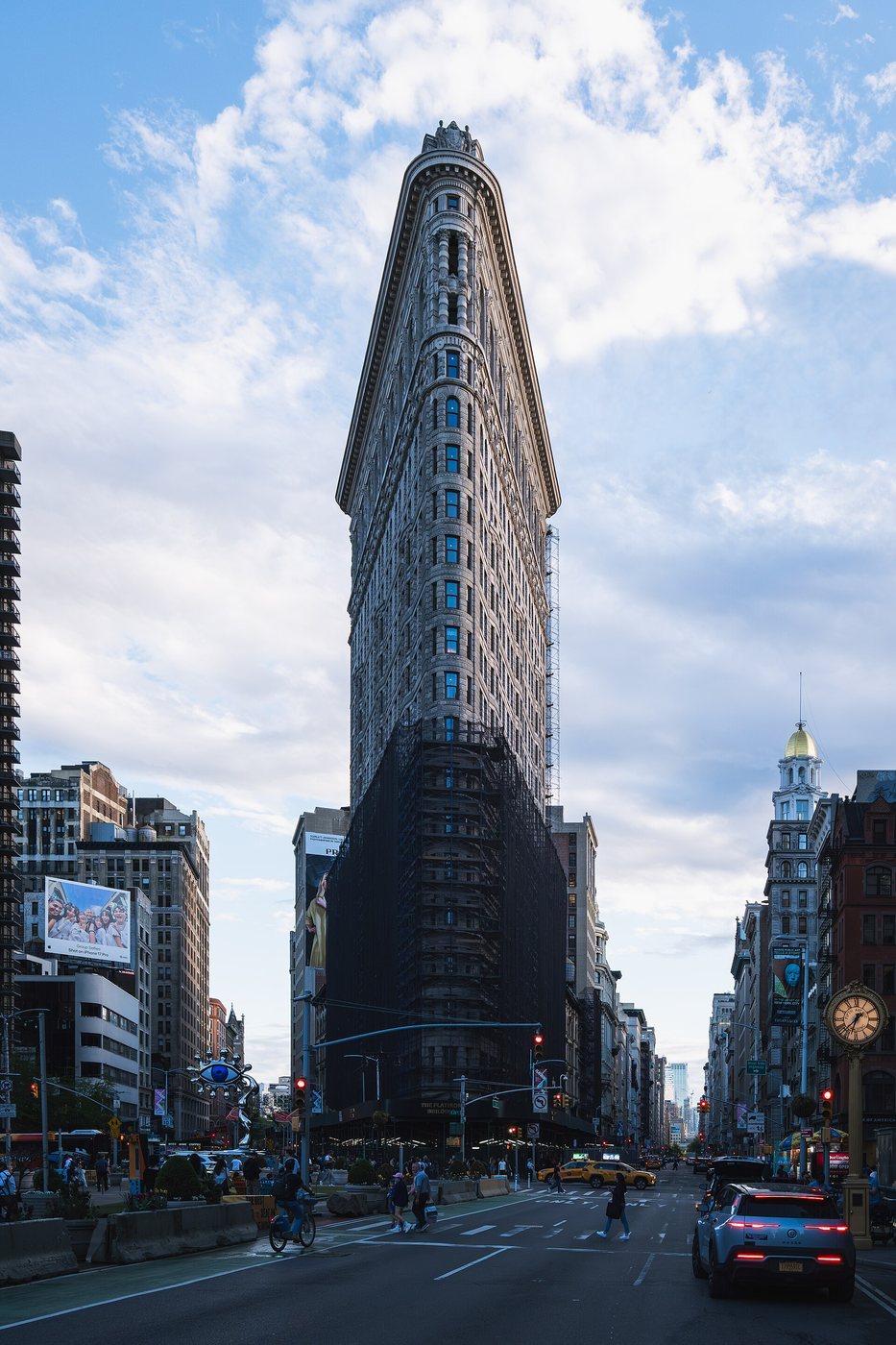
The Flatiron Building makes the shape of a city block visible. Broadway crosses Manhattan’s more regular street pattern at an angle, leaving a triangular site at Fifth Avenue and 23rd Street. The building follows that geometry upward. Its narrow end is not a sculptural flourish added to a rectangular tower; it is the architectural consequence of the land beneath it.
Compare the point with the long sides
The building was designed by D. H. Burnham & Company and opened in the early twentieth century. The Landmarks Preservation Commission’s designation report places it within the development of the modern tall office building. Its familiar nickname refers to a household iron, but the design also belongs to a commercial setting where using a valuable parcel efficiently mattered.
The pointed view can conceal the depth of the structure. Move along a public sidewalk and the thin wedge becomes a long facade with repeated window bays. The same building that appears almost impossibly narrow from one direction becomes substantial from another. This is a simple lesson in perspective: a widely reproduced photograph may describe one view accurately while giving a misleading impression of the whole.
Look upward at the division between the lower stories, the repeated middle floors and the pronounced top. This organization gives a tall commercial building something like the visual parts of a classical column. The outline responds to the street, while the treatment of the facade draws on an architectural vocabulary older than the skyscraper.
Read the intersection as part of the architecture
The building’s setting matters as much as its surface. Streets approaching from different angles create several distinct views of the same corner. A straight avenue offers a different visual approach from Broadway’s diagonal. Nearby open space lets the wedge be seen from farther away than a building squeezed into a continuous row.
Use designated crossings when moving between viewpoints. Standing in a traffic lane to align the facade removes the very context that makes the site interesting: this is a busy intersection, not an isolated monument. A view with pedestrians, signs and neighboring buildings can explain the parcel more clearly than a tightly cropped image.
Interior use and access can change, so the exterior is the dependable focus of an architectural reading. The landmark report provides the historical framework; the street provides the changing evidence of how a distinctive building occupies its city.